
Corporate Governance Sustainability
Basic Concept
We at Goldwin position, at the core of our management, the realization of a sustainable society through business activities that coexist with nature, guided by our Purpose, “Envision new possibilities for humanity in nature.” To achieve our long-term vision, PLAY EARTH 2030, we position corporate governance as corporate foundations that combine defensive aspects supported by internal controls and risk management with offensive aspects that boost growth strategies and create business opportunities. By focusing on both aspects, we are working to maximize corporate value in the medium to long term.
Specifically, we place importance on dialogue with diverse stakeholders, advance sustainability management that balances environmental consideration with earnings growth, and strengthen investment in human capital to support the autonomous challenges of each employee. In an everchanging market environment, we remain committed to sincere management grounded in high ethical standards, and will continue to drive new value creation as a company trusted by society.
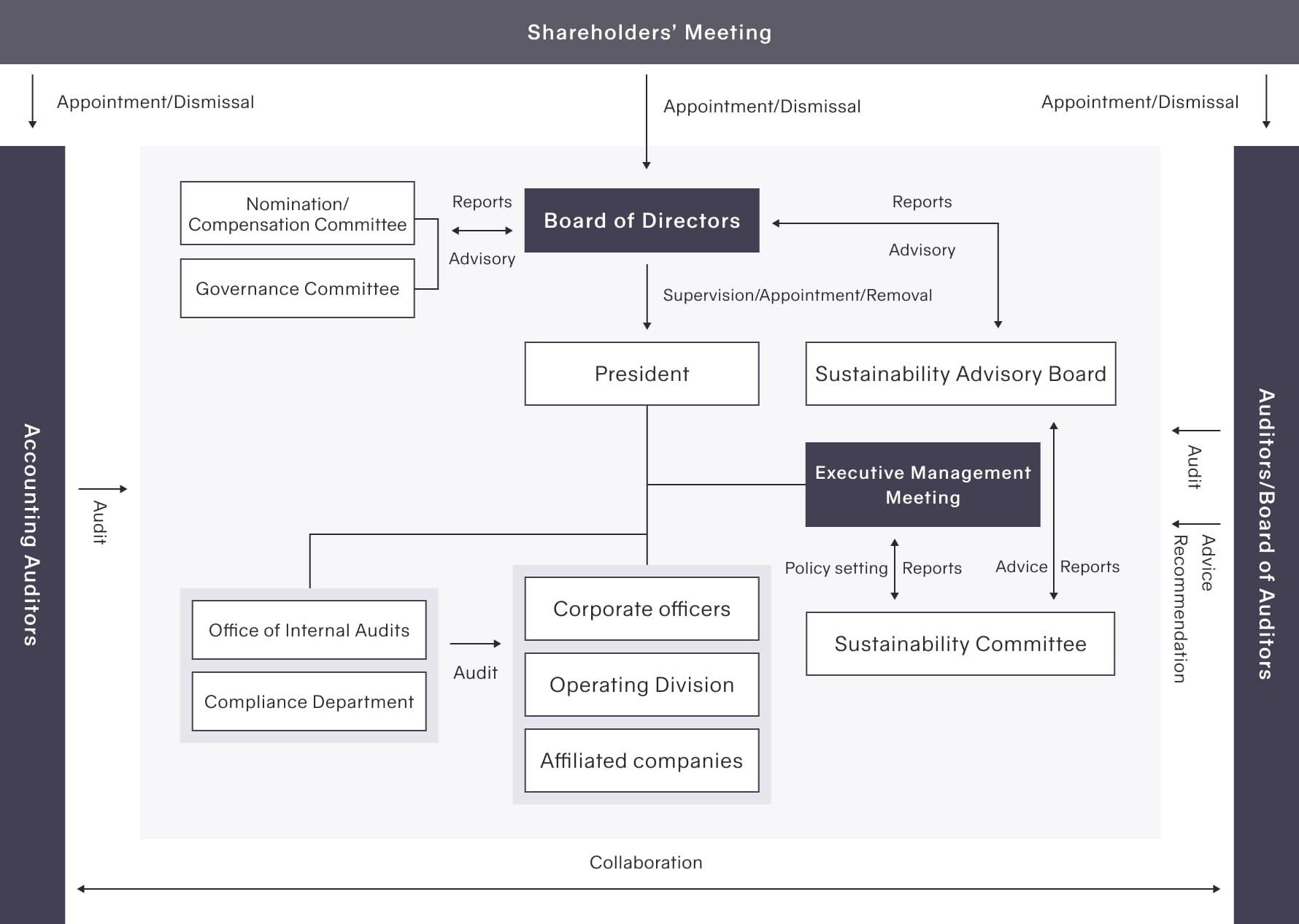
Note: Institutional design is a company with an Audit and Supervisory Board
Note: As of June 24, 2026
External directors:
6 out of 12 directors
External auditors:
3 out of 4 auditors
Female directors:
2 out of 12 directors
| Institutions | Structure | Activities |
|---|---|---|
| Board of Directors |
Chairperson: Executive Vice President 12 directors, 4 auditors |
|
| Nomination / Compensation Committee |
Chairperson: External director 3 internal directors, 5 external directors |
|
| Governance Committee |
Chairperson: External director 3 internal directors, 4 external directors, 1 full-time corporate auditor |
|
| Executive Management Meeting |
Chairperson: President and CEO 6 directors, 6 corporate officers, 1 full-time corporate auditor |
|
| Board of Auditors |
Chairperson: Full-time corporate auditor 1 full-time corporate auditor, 3 external auditors |
|
| Sustainability Advisory Board | 12 directors, 4 auditors |
|
Appointment of Directors, Auditors and Corporate Officers
In designating director and auditor candidates, their career, insights, character and other attributes are extensively reviewed by the Board of Directors, which decides the suitability of their appointment based on the content of deliberations by the Nomination/Compensation Committee, an advisory body to the Board of Directors. In the event of a director’s violation of the laws and regulations or Articles of Incorporation (of the Company) or a reason deemed to make the rightful execution of other duties infeasible, the Board of Directors deliberates and decides their dismissal or other discipline.
Corporate officers are appointed by a decision of the Board of Directors to contribute to increasing our corporate value in the medium to long term. The conditions for dismissal of corporate officers are stipulated in the Corporate Officer Guidelines. Corporate officers who meet these conditions are dismissed by a decision of the Board of Directors.
| Directors | Corporate management | Finance and accounting | Human resources and career development | Governance and legal affairs | Research and development | Manufacturing technology | Sales | Marketing | Global experience | Social/Environmental | IT | Sports literacy |
|---|---|---|---|---|---|---|---|---|---|---|---|---|
| Takao Watanabe (President and CEO) | 〇 | 〇 | 〇 | 〇 | 〇 | 〇 | 〇 | 〇 | ||||
| Michio Shirasaki (Executive Vice President and CFO) | 〇 | 〇 | 〇 | 〇 | 〇 | 〇 | ||||||
| Hikari Mori (Executive Vice President and COO) | 〇 | 〇 | 〇 | 〇 | 〇 | 〇 | 〇 | |||||
| Takero Kaneda (Director CSO) | 〇 | 〇 | 〇 | 〇 | 〇 | 〇 | 〇 | |||||
| Gen Arai (Director CRDO) | 〇 | 〇 | 〇 | 〇 | 〇 | 〇 | 〇 | 〇 | ||||
| Shinji Kawada (Director) | 〇 | 〇 | 〇 | 〇 | 〇 | 〇 | 〇 | 〇 | ||||
| Rie Akiyama (External Director) | 〇 | 〇 | 〇 | |||||||||
| Ichiro Yoshimoto (External Director) | 〇 | 〇 | 〇 | 〇 | 〇 | |||||||
| Dai Tamesue (External Director) | 〇 | 〇 | 〇 | 〇 | 〇 | 〇 | ||||||
| Akira Tsuchiya (External Director) | 〇 | 〇 | 〇 | 〇 | 〇 | |||||||
| Naoko Imoto (External Director) | 〇 | 〇 | 〇 | 〇 | ||||||||
| Tetsushi Suzuki (External Director) | 〇 | 〇 | 〇 | 〇 | 〇 | 〇 | 〇 |
Appointment of External Officers
We have established criteria regarding the independence of external officers, and appoint independent external officers who have no vested interests in the Company. We have notified the Tokyo Stock Exchange of all external directors and external auditors as independent directors/auditors. The criteria regarding the independence of external officers require that external officers must not fall under any of the following categories.
- A person who is currently, or who has in the past 10 years been, a director (excluding external directors), auditor (excluding external auditors), or employee of the Company and its consolidated subsidiaries (hereinafter collectively referred to as the “Group”).
-
A person to whom, prior to assuming their position, any of the following has applied in the past three years, including the current fiscal year.
- A current major shareholder*1 of the Company or an executive*2 of such major shareholder
-
An executive of a company or other entity that falls under either of the following
- A major client*3 of the Group
- A person in which the Group directly or indirectly holds 10% or more of the total voting rights, or an executive of such
- A person who is employed by the audit corporation that is the financial auditor of the Group
- A consultant, accountant, certified public tax accountant, attorney, judicial scrivener, patent attorney, or other professional who has received large sums of money or other assets*4 from the Group
- A person who has received a large donation*5 from the Group
- An executive of a company to which the Group’s executives are appointed as officers
- In cases where a person who falls under any of the categories in 2 above is an important person*6, the spouse or relative of that person up to the second degree of kinship
- Notwithstanding the provisions of the preceding categories, any other person who is deemed to have a special reason that may cause a conflict of interest with the Company
*1. The term “major shareholder” means a shareholder who, at the end of the Company’s most recent fiscal year, holds 10% or more of the voting rights in either their own name or in the name of another person.
*2. The term “executive” means an executive as defined in Article 2, paragraph (3), item (vi) of the Regulations for Enforcement of the Companies Act.
*3. The term “major client” means one whose transaction amounts exceed 2% of either the Company’s consolidated net sales or the client’s consolidated net sales.
*4. The phrase “large sums of money or other assets” means, in the case of an individual, an amount of 10 million yen or more per year on average for the past three fiscal years, and in the case of a corporation, etc., 2% or more of the consolidated net sales of that corporation, etc.
*5. The term “large donation” means an amount of money or other property exceeding 10 million yen per year on average for the past three fiscal years; provided, however, that, if the person receiving the donation is a corporation, partnership, or similar organization, the term means an amount exceeding 2% of the organization’s gross revenue or ordinary income, whichever is greater.
*6. The term “important person” means a director, executive officer, corporate officer, or other executive at or above the rank of general manager, or an executive with equivalent authority.
| Director | Rie Akiyama | Akiyama attended 15 of the 15 meetings of the Board of Directors held during the fiscal year under review, and asked questions and expressed opinions as appropriate based on her wealth of experience and deep insight primarily as a legal professional. As chair of the Governance Committee, she strengthened the governance framework. Also, as a member of the Nomination/Compensation Committee, Akiyama deliberated objectively on personnel matters and the compensation framework, etc. for representative directors and directors. |
|---|---|---|
| Director | Ichiro Yoshimoto | Yoshimoto attended 15 of the 15 meetings of the Board of Directors held during the fiscal year under review, and asked questions and expressed opinions as appropriate based on his wealth of experience and insight cultivated over many years as a business owner. As chair of the Nomination/Compensation Committee, Yoshimoto deliberated objectively on personnel matters and the compensation framework, etc. for representative directors and directors. In addition, he strengthened the governance system as a member of the Governance Committee. |
| Director | Dai Tamesue | Tamesue attended 15 of the 15 meetings of the Board of Directors held during the fiscal year under review, and asked questions and expressed opinions as appropriate based on his wealth of experience and insight cultivated over many years as an athlete. As a member of the Nomination/Compensation Committee, Tamesue deliberated objectively on personnel matters and the compensation framework, etc. for representative directors and directors. |
| Director | Akira Tsuchiya | Tsuchiya attended 14 of the 15 meetings of the Board of Directors held during the fiscal year under review, and asked questions and expressed opinions as appropriate based on his wealth of experience and insight in system development, digital transformation (DX) promotion, and IT capability enhancement. As a member of the Nomination/Compensation Committee, he deliberated from an objective perspective on personnel matters of the Representative Director and Directors and the composition of their remuneration. |
| Director | Naoko Imoto | Imoto attended 15 of the 15 meetings of the Board of Directors held during the fiscal year under review, and asked questions and expressed opinions as appropriate based on her wealth of experience as an athlete and experience and insight gained through about 20 years of service at international organizations. As a member of the Nomination/Compensation Committee, she deliberated from an objective perspective on personnel matters of the Representative Director and Directors and the composition of their remuneration. |
| Auditor | Hidenao Yoichi | Yoichi attended 14 of the 15 meetings of the Board of Directors and 16 of the 16 meetings of the Board of Auditors held during the fiscal year under review, and asked questions and expressed opinions as appropriate based on his wealth of knowledge and experience that he accumulated primarily in related industries and originally from working at a major trading company. |
| Auditor | Tsutomu Morita | Morita attended 15 of the 15 meetings of the Board of Directors and 16 of the 16 meetings of the Board of Auditors held during the fiscal year under review, and asked questions and expressed opinions as appropriate based on his wealth of knowledge and deep insight primarily as a bank executive. |
| Auditor | Fumio Okazaki | After taking office on June 25, 2025, Okazaki attended 11 of the 11 meetings of the Board of Directors and 13 of the 13 meetings of the Board of Auditors held during the fiscal year under review, and asked questions and expressed opinions as appropriate based on his wealth of knowledge and experience that he accumulated primarily in related industries and originally from working at a major trading company. |
Initiatives to strengthen corporate governance
We recognize that upgrading our corporate governance, while also increasing management efficiency, soundness, and transparency, are key issues for improving the common interests of our shareholders and achieving sustainable growth and increasing corporate value, and we are strengthening our systems to this end. Specifically, to execute operations swiftly and effectively, we are enhancing effectiveness by strengthening our internal control functions and implementing operational rules, including those related to authority and duties, to enhance effectiveness. At the same time, we are establishing a compliance framework, initiating risk management efforts, and ensuring management transparency and fair information disclosure.
About the Board of Directors
The Board of Directors, recognizing its fiduciary duties and accountability to shareholders, makes decisions on key business executions to achieve the Company’s sustainable growth and enhance corporate value over the medium to long term. At the same time, the Board supervises business operations, with a primary focus on the external directors. To clarify each director’s management responsibilities and establish a management system that can swiftly adapt to changes in the business environment, the directors’ terms are set at one year, thereby ensuring that shareholders’ intentions are promptly reflected.
In fiscal 2025, the Board of Directors prioritized deliberations on the following points.
[Business Plan and Medium-Term Management Policy]
The Board deliberated on the formulation of the business plan and medium-term management policy, along with significant matters related to business execution.
Establishment of the Nomination/Compensation Committee
To ensure fairness and transparency in decisions regarding the nomination and compensation of directors and executive officers, we have established a Nomination and Compensation Committee. Composed of a majority of external directors, the committee deliberates on matters related to the nomination of director and auditor candidates in response to consultations from the Board of Directors, and provides its recommendations to the Board.
In fiscal 2025, the committee prioritized deliberations on the following points.
[Remuneration for Directors and Auditors from June 2025 Onward]
The total amount of director remuneration, including basic compensation, performance-linked compensation and its KPIs, were discussed.
[Establishment of CXO]
The new CXO structure was discussed.
[Composition of the Nomination/Compensation Committee]
The member composition of the Nomination/Compensation Committee was deliberated following the retirement of a director.
[Institutional Design Looking Five Years Ahead]
The committee deliberated on the analysis and evaluation of institutional design options, establishment of institutional design goals for five years ahead, and formulation of a scheme for the composition of internal and external directors, a director successor development plan, and an internal organization scheme that align with these goals.
[Skills Matrix]
The committee revisited the skills and experience required for our directors and updated the skills matrix accordingly.
[Executive Training]
The committee members participated in a web seminar focused on the role of directors and corporate governance.
[Nomination of Director Candidates from June 2026 Onward]
The committee deliberated on the candidates for directors from June 2026 onwards based on the updated skills matrix.
Purpose of establishing the Nomination/Compensation Committee
The purpose is to strengthen governance further by seeking appropriate involvement and advice from independent external directors regarding the election of next-generation management personnel and creation of a fair remuneration system that functions as an incentive to enhance corporate value in light of our Purpose and medium- to long-term management strategies.
Authority and role of the Nomination/Compensation Committee
The Nomination/Compensation Committee deliberates and makes draft decisions on the following matters in response to requests for advice from the Board of Directors.
- Matters related to the nomination and dismissal of directors
- Matters related to succession planning (including training) for directors
- Matters related to the director remuneration system and specific amounts of remuneration
- Formulation of basic policies and standards related to the above
- Other matters for which the Board of Directors requests advice from the committee
Composition of the Nomination/Compensation Committee
To ensure independence, the Nomination/Compensation Committee consists of at least three independent external directors who are the majority. In fiscal 2026, the committee consists of eight members (including five independent external directors) and an independent external director has been elected as its chair.
Evaluating the Efficacy of the Board of Directors
Goldwin conducts evaluations on the effectiveness of the Board of Directors every year to increase the efficacy of the Board of Directors as a whole and help enhance corporate value in the medium to long term. The outline and results of evaluations for fiscal 2025 are as follows:
Evaluation Method
To ensure objectivity, we obtained advice from an external institution and carried out a survey of all of our directors and auditors, while conducting interviews with Governance Committee members.
(Major evaluation items: the composition of the Board of Directors, status of operation, quality of discussions, support system for external officers, functions of advisory committees, etc.)
Outline of Evaluation Results
The analysis of the external institution found that our Board of Directors has fostered an atmosphere of free, open-minded discussions and also put in place a support system for external officers. Therefore, we consider that the effectiveness of the Board has been secured overall.
One point that received positive evaluations in particular is that, through past reforms, the Board of Directors has steadily transitioned from a mere place for formal approval to a place for discussing management strategies and other medium- to long-term themes. More specifically, it has been confirmed that the efficiency of deliberations has increased as a result of the secretariat organizing agenda items and making improvements to handouts, enabling deeper discussions on the embodiment of our Purpose and growth strategies.
Training for Directors and Auditors
Goldwin has put in place a system to help directors and auditors to acquire and update knowledge necessary to appropriately fulfill their roles and responsibilities.
Support to Internal Officers
We actively promote and support participation in external seminars and the building of human networks through cross-industry exchanges to enable advanced decision making adapted to changes in the management environment. We also regularly hold a “training camp” for officers including external officers aimed at strengthening the cohesion of the management team and enhancing their perspectives through the sharing of medium- to long-term management issues and strategic dialogue to embody our Purpose.
Support to External Officers
When external officers assume their positions, we provide them with lectures on the overview of our business, fundamental missions, management plans, and other matters. We also continue to conduct briefings after their appointment to help them deepen understanding of business details and the latest technologies, as well as tours of our Group’s major facilities and properties, thereby offering an environment that enables them to exercise highly effective oversight and provide advice.
The costs required for these activities are, in principle, borne by Goldwin.
Executive Compensation
Goldwin’s officer incentive scheme aims to provide fair compensation corresponding to each officer’s role and responsibilities, with the basic policy of promoting sustainable growth and increasing medium- to long-term corporate value. From the viewpoint of objectivity, the remuneration system and levels are reviewed in light of economic conditions, business performance, and the standards of other companies, and the nomination and dismissal of directors are determined by the Board of Directors after deliberation by the Nomination/Compensation Committee, the majority of which are external officers.
Remuneration for fiscal 2025 (April 1, 2025 to March 31, 2026)
Remuneration for internal Directors consists of basic remuneration, performance-linked remuneration, and non-monetary remuneration, and the ratio of remuneration by type shall be determined by the Board of Directors after consultation with the Nomination/Compensation Committee. The ratio of remuneration by type is 44-53%: 28-33%: 18-28% (base remuneration: performance-linked (monetary remuneration): performance-linked (non-monetary remuneration)). External directors, who are responsible for supervisory functions, are paid only basic remuneration in light of their duties. Also, the amount of remuneration for each individual shall be determined by the Board of Directors, after consultation with the Nomination/Compensation Committee, within the maximum amount of compensation resolved at the General Meeting of Shareholders.
| Officer category | Total amount of remuneration, etc. (million yen) | Total amount of remuneration, etc. by type of remuneration, etc. (million yen) | Number of eligible officers | |||
|---|---|---|---|---|---|---|
| Fixed remuneration | Performance-linked remuneration | Retirement benefits | Including non-monetary remuneration claims | |||
| Directors (excluding external directors) | 461 | 260 | 200 | - | 69 | 9 |
| Auditors (excluding external auditors) | 21 | 21 | - | - | - | 1 |
| External officers | 82 | 82 | - | - | - | 9 |
Director Remuneration Policy
The Nomination/Compensation Committee has long recognized the relatively low proportion of variable remuneration in Goldwin’s director remuneration structure and has conducted further deliberations on the ideal director remuneration system. In a meeting held on May 22, 2025, the Board of Directors formulated a new remuneration policy for directors and decided to revise the overall structure of the current director remuneration system. The new system is subject to ongoing review in response to the Company’s business growth and changes in the external environment.
Basic Policy
- Instill awareness of the responsibility to enhance corporate value
- Motivate achievement of strategies and business plans
- Set at a level that reflects the weight of each individual’s responsibilities and role
- Set at a level that is socially and market-wise appropriate for the Company
- Set at a level that enables acquisition and retention of top talent
- Keep total remuneration within a reasonable range in light of the Company’s financial condition
Remuneration Structure
◆Remuneration Level
In line with the Basic Policy, remuneration is set at a competitive level appropriate to the Company, according to each Director’s responsibilities and role. In determining the level, objective factors are considered, including economic conditions, Company performance, levels at peer companies of similar size in Japan, and advice or survey data from external experts. Revisions will be made as needed in response to changes in the external environment.
◆Remuneration Composition
Composed of fixed remuneration (basic remuneration and allowance) and performance-linked remuneration (annual bonus and share-based remuneration).
[Fixed remuneration]
- Basic remuneration: Paid in accordance with the scale of responsibilities
- Allowance: Paid for supervisory duties of internal directors and roles such as committee chairs held by certain external directors
[Performance-linked remuneration]
- Annual bonus: Short-term incentive linked to the Company’s and the individual’s performance in the current fiscal year, designed to strengthen awareness of annual performance improvement - Share-based remuneration: Medium- to long-term incentive linked to performance over multiple years, aimed at motivating sustainable growth and enhancement of corporate value over the medium to long term as well as promoting the sharing of value with shareholders
◆Remuneration Ratio
[Internal Directors]
To strengthen motivation toward performance and corporate value enhancement, the proportion of fixed remuneration is reduced while performance-linked components are increased. The greater the responsibility and role, the higher the performance-linked and share-based remuneration components.
| Fixed remuneration | Annual bonus | Share-based remuneration |
|---|---|---|
| 44-53% | 28-33% | 18-28% |
For example, the remuneration composition ratio for the CEO is fixed remuneration: annual bonus: share-based remuneration = 44%: 28%: 28% in the case of the base amount (i.e. the remuneration amount when the level of target achievement for all evaluation indicators is 100%).
[External Directors]
Given the nature of their roles, remuneration consists entirely (100%) of fixed remuneration.
◆Timing of Payment
- Fixed remuneration: In principle, paid monthly
- Annual bonus: Paid once a year at a fixed time
- Share-based remuneration: Delivered after the Performance Evaluation Period, with a Transfer Restriction Period in place
Performance-linked Remuneration
Determined based on the degree of achievement of Company-wide and individual performance indicators. Revisions will be made as needed in response to changes in the external environment.
Remuneration Governance
Individual remuneration amounts for directors are determined by the Board of Directors, within the limit approved by the General Meeting of Shareholders, following deliberation by the Nomination/Compensation Committee, which is chaired by an external director and the majority of whose members are external directors.
[CEO]
Remuneration level and structure:
– Proposed by the Chairperson of the Nomination/Compensation Committee to the Committee
– Evaluation: Conducted by the Chairperson and external director members, with the Chairperson making a proposal to the Committee
[Internal Directors excluding the CEO]
– Remuneration level and structure: Proposed by the CEO to the Committee
– Evaluation: Conducted by the CEO and proposed to the Committee
Details of director remuneration and calculation method for fiscal 2026
The outline of the remuneration system for directors in fiscal 2026 has been determined based on Director Remuneration Policy.
Fixed remuneration
Fixed remuneration, which is composed of basic remuneration and an allowance, is a monthly monetary remuneration paid in equal installments each month. The amount of basic remuneration is set according to the significance of the role. The allowance amount is a uniform amount set based on the role.
Annual bonus
An annual bonus is performance-linked monetary remuneration paid to internal directors according to the level of performance achievement of the Company and the individual for a single fiscal year. The base amount is determined by multiplying the total remuneration base amount as director remuneration (i.e. the amount of remuneration when the level of target achievement for all evaluation indicators is 100%) by a certain ratio, and the amount of payment is determined using a formula based on the performance evaluation figures of the Company and the individual and their composition ratios, as shown below, within a fluctuation range of 0-200%. The payment is made at a certain timing after the Annual General Meeting of Shareholders for the fiscal year. The evaluation indicators and their composition ratios, as well as the maximum value, target value, and threshold value of each indicator for setting the fluctuation range of 0-200% for the payment amount of each individual, are determined by the Board of Directors following deliberation by the Nomination/Compensation Committee.
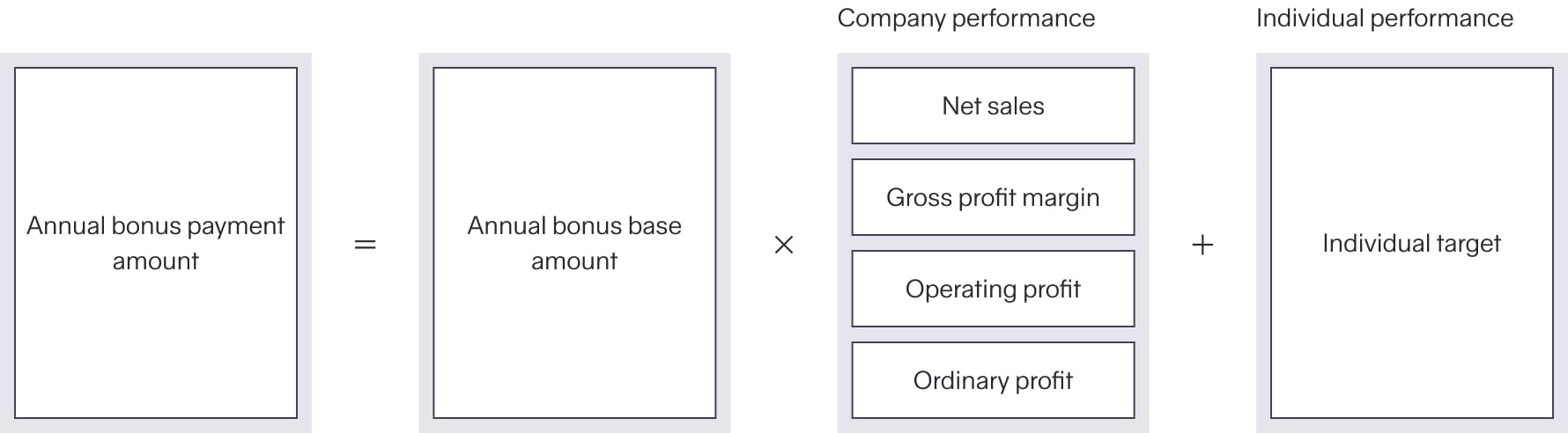
| Evaluation indicator | Composition | Evaluation details and objectives | ||
|---|---|---|---|---|
| CEO and Vice President | COO, CFO, and CSO | Other Directors | ||
| Net sales | 20% | 25% | 25% | Growth and business expansion over the fiscal year |
| Gross profit margin | 20% | 25% | 12.5% | Appropriate pricing, brand positioning, and manufacture supply costs |
| Operating profit | 20% | 25% | 12.5% | Expansion of cash flow sources and earning power |
| Ordinary profit | 20% | 0% | 0% | Strengthening of the profitability of equity-method affiliates |
| Individual target | 20% | 25% | 50% | Enhancement of strategic initiatives of individuals |
Share-based remuneration
Share-based remuneration is performance-linked restricted shares granted to internal directors according to the level of performance achievement of the Company for three consecutive fiscal years. Each fiscal year, the Company grants base units calculated based on the base stock price and the base amount determined by multiplying the total remuneration base amount as director remuneration by a certain ratio. After the three consecutive fiscal years that starts from the fiscal year to which the unit grant date belongs, shares of the Company’s common stock are allotted with transfer restrictions on the basis of one unit per one share following adjustments to the number of units using a formula based on the performance evaluation figures of the Company and their composition ratios, as shown below, within a fluctuation range of 0-200%. The transfer restrictions are lifted at the time of retirement. The evaluation indicators and their composition ratios, as well as the maximum value, target value, and threshold value of each indicator for setting the fluctuation range of 0-200% for the payment amount of each individual, are determined by the Board of Directors following deliberation by the Nomination/Compensation Committee.

| Evaluation indicator | Composition | Evaluation details and objectives |
|---|---|---|
| ROE | 80% across the board | Improvement of capital efficiency and promotion of value sharing with shareholders |
| ESG | 20% across the board | Sustainability initiatives |
| Evaluation indicator | Composition | Evaluation details and objectives |
|---|---|---|
| ROE | 80% across the board | Improvement of capital efficiency and promotion of value sharing with shareholders |
| ESG | 20% across the board | DEI promotion (promotion of female empowerment and the employment of persons with disabilities) |
Remuneration system for auditors
Given their role of auditing the execution of duties by directors, performance-linked remuneration will not be introduced for auditors, and their remuneration consists entirely of fixed remuneration (monetary).
Method for determining officer remuneration
The amount of remuneration for each individual shall be determined by the Board of Directors, after consultation with the Nomination/Compensation Committee, within the maximum amount of compensation resolved at the General Meeting of Shareholders.
The amount of remuneration for each Auditor is determined by discussion at the Board of Auditors. Regarding the maximum amount of monetary remuneration for directors, it was decided that an annual amount not exceeding 800 million yen (of which up to 100 million yen for external directors) be proposed at the 74th Annual General Meeting of Shareholders held on June 25, 2025. The number of directors subject to the resolution is twelve (including six external directors). The maximum remuneration for auditors was resolved at the 65th Annual General Meeting of Shareholders held on June 23, 2016 to be an annual amount not exceeding 70 million yen. As of the conclusion of the said General Meeting of Shareholders, the number of
auditors was four (including three external auditors).
Approach to Cross-shareholding
Basic policy
Goldwin’s basic policy is to continuously examine the significance of cross-shareholdings and seek optimization from the perspective of enhancing corporate value and capital efficiency in the medium to long term. When holding shares, we comprehensively take into consideration cooperative relationships in development, procurement, finance, and other areas indispensable for our sustainable growth, as well as necessity in terms of business strategies. If it is determined as a result of examinations that the significance of cross-shareholdings has been reduced, we will consider reviewing the holding of these stocks, including their disposal, while taking into consideration dialogue with partner companies and market trends.
Examination regarding the appropriateness of continued holding
With regard to the stocks that continue to be held, the Board of Directors examines each stock every year to determine whether the benefits and risks associated with holding are commensurate with the capital cost and whether holding is necessary due to medium- to long-term management strategies. If the examination finds that the continued holding is not appropriate, our policy is to proceed with disposal of these stocks while considering the market environment and other factors.
Exercising of voting rights
In exercising voting rights pertaining to cross-shareholdings, we carefully assess the management status and governance system of the issuing company, determine on a case-by-case basis whether the presented proposal will contribute to the enhancement of our corporate value and the sustainable growth of the issuing company, and exercise our voting rights appropriately.