
Promotion of Green Design Sustainability
Basic Concept
The apparel industry is associated with large-scale negative impacts on society and the environment, including greenhouse gas emissions, water consumption and mass disposal of product. We need to shift to products that can be used safely for long from products with short life cycles and high environmental impacts.
The Group aims to enhance environmental sustainability and provide products that consumers can use safely for long, and is actively developing products made from recyclable raw materials with low environmental impact.
Key Environmental Issues
We have proactively developed products using renewable materials with minimal environmental impact, aiming to increase environmental sustainability and provide consumers with products that are safe and useful over the long term. Our medium-term management plan made in 2021 includes promotion of green design as a priority issue.
The ratio of products that use materials with reduced environmental impact is incorporated into the key target items of each business division, and their progress is checked each month at the Administrative Office of the EMS Committee chaired by our President and Representative Director.
Expanding Products that Use Materials with Reduced Environmental Impact
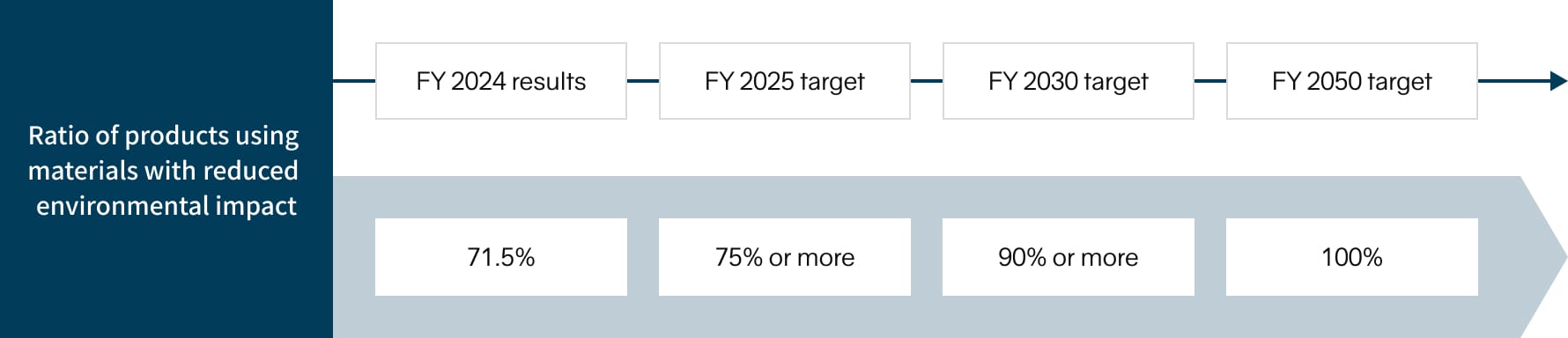
The medium- to long-term targets were clarified under the Medium-term Management Plan formulated in 2021, and the use of materials with reduced environmental impact is increasing across the Company. The ratio of products using materials with low environmental impact in 2023 was 65.3%. We will continue to proactively develop products using materials with reduced environmental impact, including plant-based materials such as Brewed Protein™, a structural protein material, as well as recycled and upcycled materials.
Standards for products that use materials with reduced environmental impact
We set our own certification standards for each process involved in manufacturing our products. We refer to raw materials that contribute to reducing environmental impact as GREEN MATERIAL. This includes recycled materials such as recycled polyester, recycled nylon, recycled down and recycled wool, as well as plant-derived materials such as Lyocell and Modal fibers made from trees grown in tightly controlled, sustainable forest and polyurethane manufactured using castor oil. Products manufactured from materials containing at least 25% of these are designated as GREEN PRODUCTS. The ratio of products using materials with reduced environmental impact in 2024 was 71.5%. We are currently preparing new standards to strengthen our environmental response, aiming to make all products GREEN PRODUCTS by 2050, and will continue our daily efforts to research and develop raw materials and resources.
Promoting Conversion to Recycled Materials
The majority of sports apparel uses polyester, nylon and other materials derived and manufactured from petroleum. We will proactively shift to recycled materials not dependent on depleting fossil fuel sources through initiatives to use recycled polyester and nylon obtained from used garments, fiber products and PET bottles, and to reuse for new products the recycled down feathers after washing and reviving them. Used clothes for recycling are also collected at our stores to facilitate circulation of limited resources.
Utilization of Auxiliary Materials to Reduce Environmental Impact
We will improve the usage rate of recycled raw materials and plant-based materials with reduced environmental impact in primary materials for products, and promote utilization of materials that have little impact on the environment for product accessories. such as zippers. Also, we will further reduce environmental impacts of auxiliary materials by reducing containers, packaging and labels, and selecting recyclable materials.
Future Issues
We will continue to develop materials and products with reduced environmental impact, further lessen the environmental impact including the manufacturing procedures, and work toward our goal of making all products GREEN PRODUCTS by 2050.