
Sustainability Policy and Materiality Sustainability
Our mission at the Goldwin Group is twofold: to manufacture sports apparel that helps people lead fulfilling and healthy lives, and to ensure sustainability for the earth and human societies.
From climate change and biodiversity loss to poverty and human rights abuses, the world faces a wide range of social and environmental problems that call for global action. Corporate entities must take steps to solve these problems through their business activities. As a manufacturer involved in the apparel industry — an industry for which environmental impacts and human rights issues are real concerns — we understand how important it is that we address these issues with honesty and sincerity.
Addressing social and environmental issues across our value chain, from manufacturing to sales, is also vital to fulfilling our responsibilities. These principles are laid out clearly in our sustainability policy, which is shared among all the companies in our Group.
Goldwin Regenerative Journey
Goldwin Regenerative Journey
(Sustainability Policy)
-
Nature
- Creating maximum value from minimum resources to restore the earth’s nature cycles
-
People We Inspire
- Sharing the joy of playing in nature to nurture children’s ability to envision the future
-
Co-Creators
- Fostering continuous learning and play to help people imagine a beautiful future together
Our Sustainability Policy and Stories
At Goldwin, we take as our Purpose “Envisioning new possibilities for humanity in nature,” with the goal of a brighter future for all life on the earth. The Goldwin Regenerative Journey, established in May 2026, sets out our policy on sustainability as well as the commitment to embody our Purpose that we make to our stakeholders. Our stakeholders — nature, the people we inspire, and our co-creators — are not three separate groups. They intersect and interact to form a single integrated cycle that underpins our value creation. The Goldwin Regenerative Journey is the policy that guides us as we move forward, ever advancing our contributions to the world.
Nature
Creating maximum value from minimum resources to restore the earth’s nature cycles
All life on Earth — including human life — depends on our planet’s irreplaceable cycles of nature, yet it is humans who have most profoundly impacted the intricate balance of these cycles. We recognize our responsibility to restore this balance, and we see it not as a constraint, but as an opportunity for regeneration and creation. The challenge we set ourselves is bringing imagination and technology together in innovative ways that generate more value using fewer of the earth’s limited resources. We want to build a world in which the more comfortable human lives become, the more nature flourishes. By promoting this kind of circular economy, we will help to restore the natural balance of the earth’s ecosystems and ensure a sustainable future.
People We Inspire
Sharing the joy of playing in nature to nurture children’s ability to envision the future
Children are the very future of human societies, and we see future generations as stakeholders as important as any other. Beyond just short-term profit and performance, our work focuses on the way that future generations will live and how society will function. Play in nature is more than just physical. It is about the emotional experience of being moved by beauty, encountering the mysterious, and asking questions. Spending time playing in nature nurtures the imagination and fosters the ability to think about the future. We envision greater potential in manufacturing, not just manufacturing products but also providing value through the experiences they produce, the emotions they evoke, and the feeling of reconnecting with nature. Imagine how many more people would develop a love of nature and begin to think about the future if we were to provide more opportunity to experience nature and share that feeling with others. That’s the world we believe in — one in which all life, now and in the future, is equally able to flourish in a beautiful world.
Co-Creators
Fostering continuous learning and play to help people imagine a beautiful future together
Continuous learning and plenty of playtime nourish the ability to envision a beautiful future. When people encounter new worlds and a variety of values, they are freed from preconceived notions and opened up to create new ideas. Our employees, suppliers, and business partners come together to create value, rather than relying on one person’s idea of the “correct” answer. It is by respecting different perspectives, tapping into different backgrounds, putting our heads together, and taking on challenges as a team that we shape the future. Learning and playing, fostering our imagination with a diverse group of co-creators, we dedicate ourselves to creating a today that is a little better than yesterday, and a tomorrow that will be a little better than today.
Materiality
Under our sustainability policy, we have identified material topics for our three groups of stakeholders, defining 12 material topics.
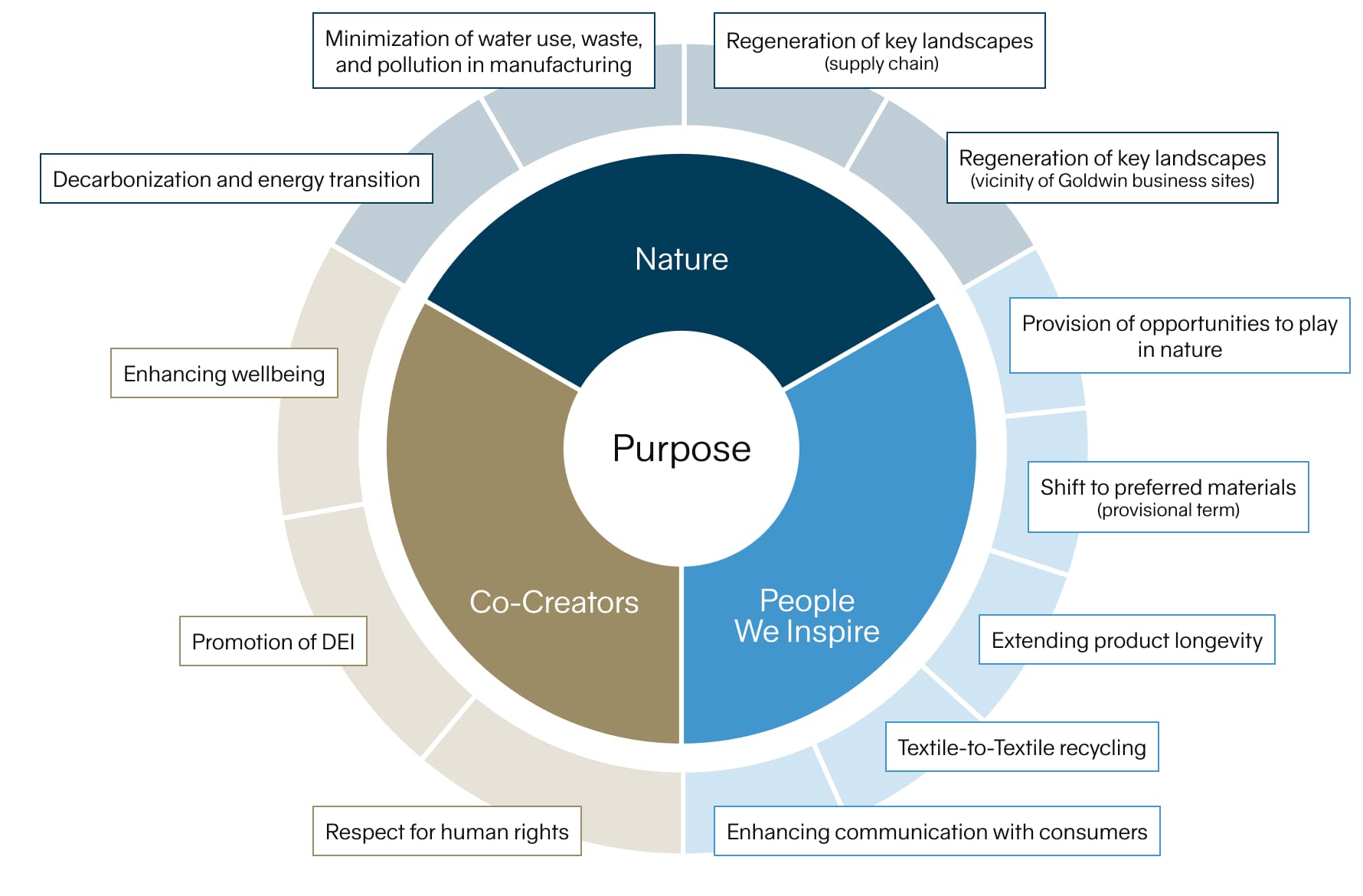
Defining Materiality
We at Goldwin apply a systematic process to defining material topics in light of the impact of our business activities on both the environment and society, as well as the expectations that our stakeholders have of us. We first delineate the scope of the assessment, then evaluate impact, identify material topics, and engage with stakeholders, before materiality is ultimately deliberated and approved by the Board of Directors.
Our Board of Directors oversees periodic reviews of materiality in light of changes to our management and business strategies, social conditions, environmental and social issues, and stakeholder expectations. These repeated evaluations at regular intervals make for increasingly more valid and effective definitions of materiality.
Process for Defining Materiality
Step 1: Delineate the scope of assessment
We comprehensively identify both the positive and negative environmental and social impacts associated with our business and value chain. Based on the nature of our business, we reference the European Sustainability Reporting Standards (ESRS), the standards issued by the Global Reporting Initiative (GRI) and the Sustainability Accounting Standards Board (SASB), as well as assessment criteria from environmental, social, and governance (ESG) rating agencies.
Step 2: Evaluate impact and identify material topics
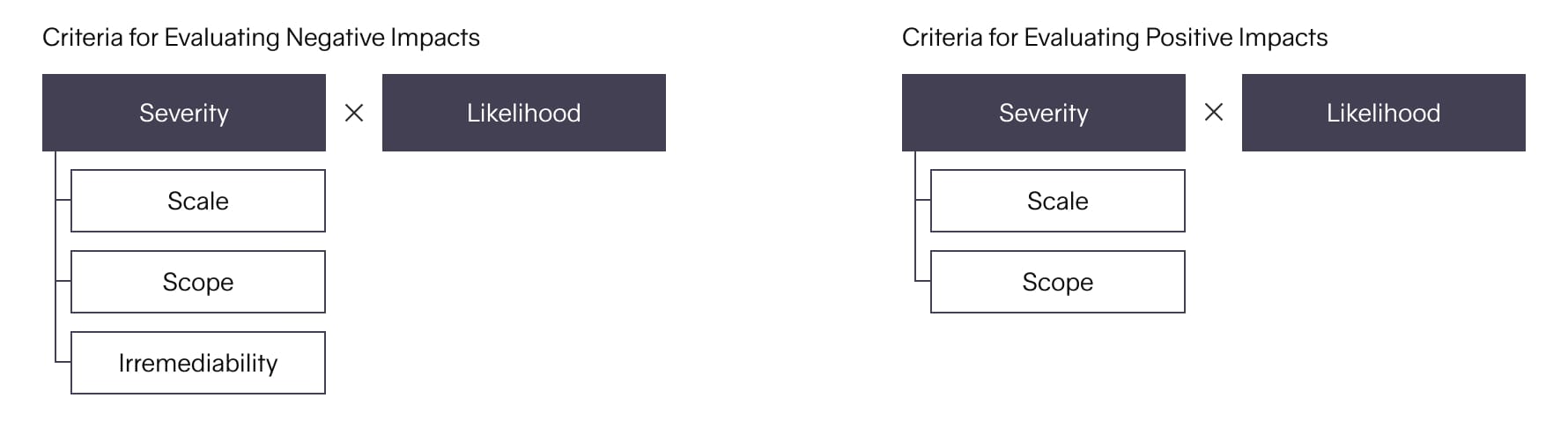
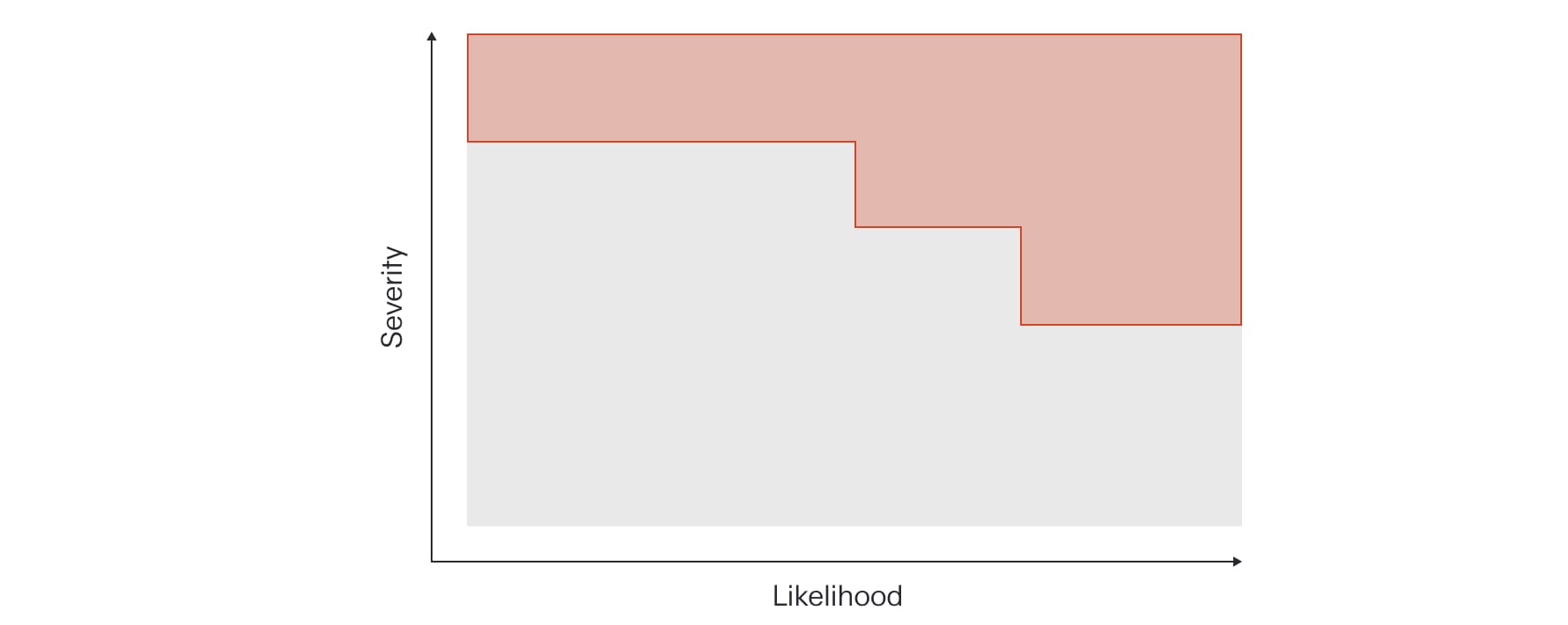
Having identified positive and negative impacts, we conduct impact assessments based on severity and likelihood. We map the assessment results and define material topics as those whose impact exceeds a certain threshold.
When setting thresholds, we prioritize severity, classifying an issue as material if its severity is high, even if its likelihood is low.
Evaluation Criteria and Approach to Thresholds
| Material topics | Pos/Neg | Upstream | Goldwin | Downstream | |
|---|---|---|---|---|---|
| 1 | GHG emissions | Neg | ✓ | ✓ | ✓ |
| 2 | Loss of ecosystem/biodiversity | Neg | ✓ | ✓ | |
| 3 | Water/marine pollution | Neg | ✓ | ✓ | |
| 4 | Soil contamination | Neg | ✓ | ||
| 5 | Water use/water intake from high-risk areas | Neg | ✓ | ||
| 6 | Resource use (leading to resource depletion) | Neg | ✓ | ||
| 7 | Waste management | Neg | ✓ | ✓ | |
| 8 | Human rights/labor | Neg | ✓ | ✓ | ✓ |
| 9 | Product quality and safety | Neg | ✓ | ||
| 10 | Social inclusion | Pos | ✓ | ||
| 11 | Provision of nature-based experiences | Pos | ✓ | ||
| 12 | Transformation of consumer behavior | Pos | ✓ | ||
| 13 | Impact on local communities | Pos | ✓ | ||
Goldwin: Development, design, distribution, sales
Downstream: Product use, waste, recycling
Step 3: Propose material topics
We propose material topics by cross-referencing the material topics we identify with our sustainability policy and business strategies to consolidate and restructure these issues.
Step 4: Engage with stakeholders
We dialogue with, interview, and survey our employees, suppliers, customers, investors, local communities and external stakeholders in the environmental sector to reflect their perspectives in our materiality. We integrate stakeholder perceptions of our positive and negative impacts, and their expectations in this regard, into our impact assessments and material topics to confirm their legitimacy.
Step 5: Approval and governance
The overall process and identified material topics are reviewed by our Board of Directors. The Executive Management Meeting conducts final deliberations and approves target-setting for material topics under the Board’s supervision.
Our sustainability management is materiality-driven, and to ensure that this approach is as effective as possible, our system of executive compensation is linked to materiality-related metrics, with executive compensation reflecting the level of achievement in relation to these metrics.
| Sustainability Policy | Material topic | FY2026 Targets | |
|---|---|---|---|
| Nature | 1 | Decarbonization and energy transition | • Scope 1 & 2: Reduce greenhouse gas (GHG) emissions by minimum of 18% compared to FY2023 • Increase ratio of renewable energy in Goldwin electricity consumption to 70% or more • Scope 3: Begin collecting primary data on GHG emissions from priority suppliers in supply chain |
| 2 | Minimization of water use, waste, and pollution in manufacturing |
• Reduce product and material waste in Goldwin operations by minimum of 85% compared to FY2020, bringing total waste volume down to 4.3 metric tons or less • Begin collecting quantitative data on water use, waste, and pollution from priority suppliers in supply chain |
|
| 3 | Regeneration of key landscapes (supply chain) |
• Begin traceability surveys that cover entire supply chain to raw materials • Participate in restoration projects in regions where raw materials are produced |
|
| 4 | Regeneration of key landscapes (vicinity of Goldwin business sites) | • Promote restoration of ecosystems in vicinity of main business sites in Toyama region | |
| People We Inspire | 5 | Provision of opportunities to play in nature | • Develop strategies to create social impact through nature-based experiences |
| 6 | Shift to preferred materials (provisional term) |
• Establish new standards for materials used in footwear and bags • Establish management framework to facilitate transition to material weight-based management |
|
| 7 | Extending product longevity | • Formulate basic policy on extending the longevity of products | |
| 8 | Textile-to-Textile recycling | • Formulate basic policy on implementation of textile-to-textile recycling | |
| 9 | Enhancing communication with consumers |
• Establish policy and operational framework regarding responsible communication • Formulate sustainability communication strategies targeting consumers |
|
| Co-Creators | 10 | Respect for human rights |
• Identify significant human rights issues and develop medium-term action plan • Introduce grievance mechanism for suppliers |
| 11 | Promotion of DEI |
• Formulate Goldwin Group policy on diversity, equity and inclusion (DEI) and establish framework for implementation • Increase proportion of women in management positions to 14% by April 2027 (non-consolidated) |
|
| 12 | Enhancing wellbeing | • Establish Goldwin definition of and metrics for wellbeing | |
At Goldwin, we set specific targets that serve as action plans for each material topic and actively focus on meeting these targets. We are currently working on setting medium-term targets and KPIs for each of our materiality by the end of FY2026.